
Branchways News & Views
Branchways: The What and the Why
by Jason Benoit
posted 2026-01-20
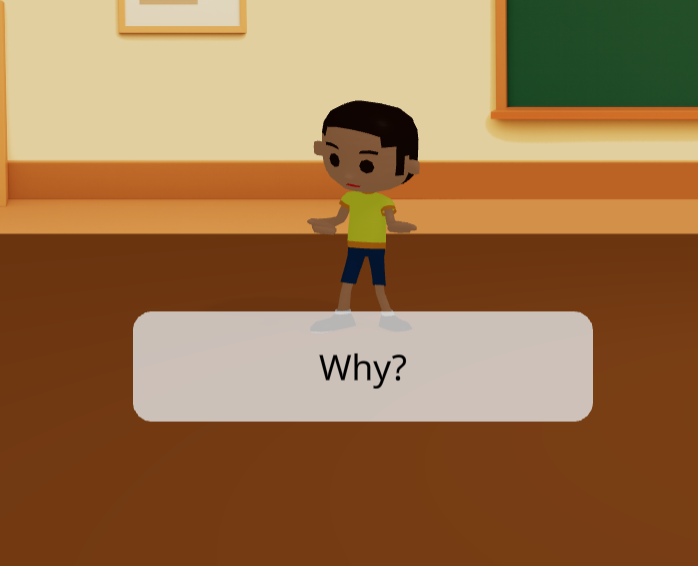
What is Branchways and why should you care about it? In this article, I'll answer both questions and also share how and why I began developing Branchways.
What is Branchways?
Branchways is an online platform for creating, playing, and sharing interactive scenarios rendered as 3D animations, where the story unfolds based on the user’s choices. Branchways lets people easily build dialogue-driven simulations in which characters interact and the user periodically chooses what happens next.
This format is a natural fit for many training and learning contexts—diagnostic practice, social-skills lessons for children, professional communication scenarios, and so on—though its potential uses go far beyond these examples. Branchways includes optional AI assistance to help generate scenarios, but creators always retain complete control, and every scenario can be built entirely from scratch. Branchways scenarios are ideal for blending formative and summative assessment strategies, offering non-intrusive, process-oriented evaluation as well as instant, context-driven feedback that students immediately understand.
As of this writing, Branchways is still in active development; however, the core UI, AI-assisted scenario generation, and scenario playthrough are already functional, and a pre-release demo is coming soon. Planned features include:
- Advanced Accessibility Features: Branchways was designed with accessibility in mind from day one. All dialogue is displayed as on-screen text, and the underlying data model and event-driven architecture make it possible to render animations in alternative formats in real time.
- LMS Integration: Branchways can collect assessment data from activities and share it with major learning-management systems via the LTI specification without requiring student personal information.
- User Extensibility: Users can add their own assets, settings, and themes, allowing the entire look and feel of a scenario to be personalized.
- Embedded Mini-Activities: Quizzes, puzzles, games, and other interactives embedded within the branching scenario framework.
Why Branchways?
This question can be broken down into two more specific questions: 1) Why did I start building Branchways; and 2) Why should you care? I will first give a brief outline of how I came to create Branchways before delving into the reasons you should consider using it.
Why Did I Begin Building Branchways?
There are all kinds of reasons why people build software platforms, or indeed undertake any kind of creative project: dreams of recognition, hopes of material reward, the recognition of the solution to a particular need or problem, or the simple satisfaction of building and experimenting. Sometimes a creator might not even realize the true nature of the creation at first, as simple curiosity or a desire to develop knowledge or skill in a certain area drives the germinal phase of the project.
It was this last reason -- curiosity and a desire to explore new skills and approaches as a software developer -- that inspired the initial phase of Branchways' development. I wanted to see what I could do in terms of a browser-based application that incorporated animation while promoting user creativity. My experience in instructional design at the post-secondary level had made me aware of the types of interactive activities used as instructional aids, and designing software for education was a natural direction for me to continue applying myself. It was important to me that the application have the following characteristics:
- Easy to use: I wanted to design something that was powerful and versatile but spared the user having to learn to navigate a complicated interface. It was important to me that users would be able to dive in without spending a bunch of time studying help documentation.
- Simple to Extend: For myself or anyone on the development side, I wanted the program to be structured in such a way that it was easy to add new features and components without rewriting a lot of existing code. This modular structure would also make it simple to allow the user to customize the program down the road (add their own models, for example).
- Accessible: While this is a visually focussed program, I wanted to make sure that text alternatives and captioning for actions were available for users with accessibility challenges, and that especially on the student side there were no complex controls to navigate
- Exportable/Embeddable: I wanted to ensure that the software plays nice with existing LMS technology.
When I first started working on Branchways, I wasn't necessarily committed to bringing it to production. It was more of an interesting side project to my day job, possibly something to beef up my resume, rather than something I envisioned making publicly available. Yet, as the project grew, I began to see that it had real potential, and that even its value as a portfolio piece would be enhanced by sharing it with the world, and doing the production cycle work that this entailed.
All of which brings me to...
Why Should You Care About Branchways?
Interactive simulations and "serious games" like Branchways have been shown by research to enhance situational and experiential learning by transferring knowledge from real-life situations 1, and there are plenty of interactive educational activites to choose from. However, the same research has also shown that simulations and games are most successful when the activity is sufficiently specific, is meaningfully integrated in the overall course of study, and where an instructor knows the activity well enough to provide guidance to students2.
It is in fulfilling these conditions -- namely specificity, course integeration, and teacher understanding -- that Branchways truly shines.
By empowering educators to easily customize interactive learning activities to their unique needs, Branchways allows the production of activities that are tailored exactly to the material being taught. Even when using a pre-existing activity or one generated by AI, teachers can quickly navigate through the activity in order to understand it and customize it if need be. The same activity can even be versioned differently for different sets of students, or students can be given assignments in which they create their own branching scenarios. Branchways can be used for storyboarding, brainstorming, or any number of other classroom applications -- creativity is the only limit.
If any of this interests you, be sure to sign up for the upcoming free pre-release demo at branchways.net and share your thoughts. Hope to hear from you soon!
References
-
Bellotti, Francesco, Kapralos, Bill, Lee, Kiju, Moreno-Ger, Pablo, Berta, Riccardo, Assessment in and of Serious Games: An Overview, Advances in Human-Computer Interaction, 2013, 136864, 11 pages, 2013. https://doi.org/10.1155/2013/136864
-
Tatiana Kikot, Gonçalo Costa, Rui Magalhães, Silvia Fernandes, Simulation Games as Tools for Integrative Dynamic Learning: The Case of the Management Course at the University of Algarve, Procedia Technology, Volume 9, 2013, Pages 11-21, ISSN 2212-0173, https://doi.org/10.1016/j.protcy.2013.12.002.
-
Vlachopoulos, D., Makri, A. The effect of games and simulations on higher education: a systematic literature review. Int J Educ Technol High Educ 14, 22 (2017). https://doi.org/10.1186/s41239-017-0062-1
Footnotes
-
Lukosch, H., Kurapati, S., Groen, D., & Verbraeck, A. (2016). Microgames for situated learning a case study in interdependent planning. Simulation & Gaming, 47(3), 346–367 (2016). Doi: 1046878116635468. ↩
-
Bellotti, F., Kapralos, B., Lee, K., Moreno-Ger, P., & Berta, R. (2013). Assessment in and of serious games: An overview. Advances in Human-Computer Interaction, 2013, 1. ↩